

Need Professional Help with Addiction?
Behavioral Health FAQs
Table of Contents
- How Long Do Drug Test Results Take? What You Need to Know Before You Test
- What is a Drug Test?
- What Types of Drugs Can You Be Tested For?
- What Would Someone Need a Drug Test For?
- What Happens During a Drug Test?
- How Can I Interpret the Test Results?
- How Long Does it Take to Get Drug Test Results? Getting the Answers You Need
Key Points
- The time that drug test results take to come back varies depending on the type of test, the provider, and the facility where the test is done.
- Urine drug testing is the most common type of drug test.
- Other types of drug tests include taking a blood, saliva, or hair sample.
- You may be tested for a variety of drugs, including alcohol, opioids, marijuana, and cocaine.
- A drug test will be positive when there is enough of one or any substance in your system.
- A negative test result means the drug was not in your system or there was not enough of it to register a positive result.
There are many different factors that contribute to how long you can expect drug test results to take. The type of test being administered, the provider giving the test, and the lab running the test are just a few of the components that can impact the general turnaround time. Waiting for drug test results can make anyone nervous. But being aware of the time window that you can typically expect results can make that wait time a little less frustrating.
How Long Do Drug Test Results Take? What You Need to Know Before You Test
There is no one answer to the question of how long drug test results take because it depends on the type of test and sample. Sometimes you can expect a turnaround of a few hours, while other tests can take days to come back. [1]
What Factors Affect the Timing?
The type of drug test, the facility, and the reason for the test will determine the timing of the results. [2] Urine and blood tests usually have the quickest result window.
What is a Drug Test?
A drug test is done to look for illegal drugs or prescription medicines that people may misuse. [3] It can spot one or more drugs in a person’s system.
Types of Drug Tests
There are several different samples you could be asked for when you have to take a drug test. [4]
Urine drug testing
A urine screening is the most common drug test. It requires you to give a urine sample. When you provide a sample, it is typically used to look for alcohol, amphetamines, opiates and opioids, marijuana, cocaine, and benzodiazepines.
Breath test
A breath test is most commonly used to see if there is any alcohol in your system. The breath alcohol concentration can detect a person’s blood alcohol content (BAC). The BAC measures how much alcohol is in your blood from drinking. [5]
Blood test
This is typically used to detect alcohol levels. It is mainly used in emergencies because it can give a precise level.
Saliva test
During a saliva drug test, a swab is used to collect saliva and cells from the inside of the cheek. This can be used to test for alcohol or a variety of drugs. It can be sent to a lab for analysis or may be done on-site, depending on the facility.
Sweat test
When you’re given a sweat test, you’ll have to wear an absorbent pad on your skin. It is collected and tested for a set time. The results will show how much of a substance a person consumed while wearing the pad.
Hair follicle test
A hair sample can give insight into substance use over time. Scalp hair can have a detection window of up to three months. Body hair has a detection window of up to 12 months. This type of drug testing can be used to look for cocaine, PCP, opioids, MDMA, and amphetamines.
What Types of Drugs Can You Be Tested For?
Drug tests can look to see if you have many different types of drugs in your system. These are some of the most common drugs that you may be tested for: [6]
- Alcohol
- Cocaine
- Marijuana
- Opioids and Opiates (Heroin, Codeine, Morphine, Hydrocodone, Oxycodone, and Fentanyl)
- Amphetamines (Ecstasy, methamphetamine)
- Benzodiazepines (Alprazolam, Clonazepam)
- Anabolic steroids
- Phencyclidine
Drug Detection Windows
Drugs can last in your body for various amounts of time. It depends on what type of drug you used, how much you used, how long before the test you used it, and how you react to it. [7]
Here’s a look at the typical detection windows for drugs during testing: [8]
- Alcohol
- 10-12 hours in urine
- Up to 24 hours in saliva
- Barbiturates
- Up to 7 days in urine
- Up to 90 days in hair
- Cocaine
- 2-4 days in urine
- Up to 90 days in hair
- 1-36 hours in saliva
- Marijuana
- 1-30 days in urine
- Up to 90 days in hair
- Up to 24 hours in saliva
- Amphetamines
- 2-4 days in Urine
- Up to 90 days in hair
- 1-48 hours in saliva
- Methamphetamine
- 2-5 days in urine
- Up to 90 days in hair
- 1-28 hours in saliva
- Heroin
- 2-3 days in urine
- Up to 90 days in hair
- 1-36 hours in saliva
- PCP
- 5-6 days in Urine
- Up to 90 days in hair
What Would Someone Need a Drug Test For?
There are several different reasons why someone may need a drug test: [9]
Treatment for Substance Use Disorder: If someone is undergoing treatment, a facility may order a drug test to make sure there has been no relapse.
Pre-Employment Screening: Many employers require prospective employees to pass a drug test before they are hired. If you pass and are hired, you may be subject to random drug testing throughout your employment. Many companies require a drug-free workplace.
Sports: Professional athletes and student athletes may be tested for drugs, such as steroids. Steroids are performance-enhancing drugs that can help build muscle.
Criminal Investigation: Drug tests can be ordered as part of a criminal investigation or a motor vehicle accident investigation.
Prescription Drug Misuse: If you are prescribed a drug, such as opioids for long-term pain, your doctor may order a drug test to make sure you are not using the medicine incorrectly.
What Happens During a Drug Test?
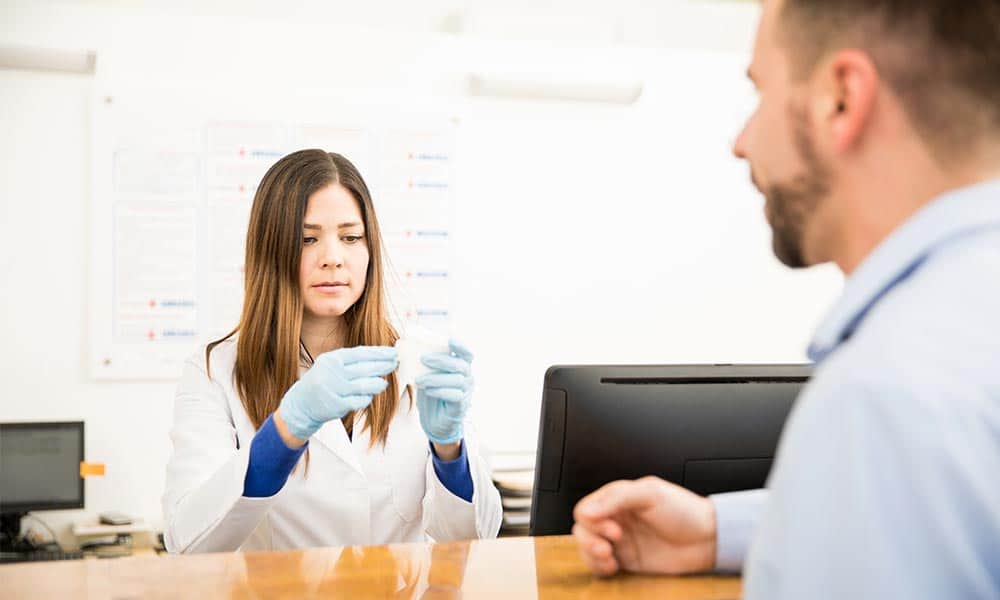
During a drug test, you will be asked to give a sample of whatever specimen is being collected. If it is a urine sample, you will have to pee in a container that will be provided to you. In some cases, you may need to do so in the presence of a medical professional to confirm that it is truly your sample.
For a blood test, a phlebotomist will draw a small blood sample from your arm or hand. A breath test requires you to breathe into a machine. Other specimens, such as hair follicles, are manually extracted by medical professionals. Once the sample is collected, it is sent to a lab for testing and analysis.
How Can I Interpret the Test Results?
If your drug test is positive, one or more drugs were found at a level that suggests drug use or drug abuse. [10] Typically, you will have to have a follow-up test to make sure the first result was not a false positive.
A false-positive indicates that there was a drug in your sample that really wasn’t there. This happens when the test reacts with other things in your body. This can be from food or over-the-counter medicines. A follow-up test will be more sensitive to provide the most accurate results.
Negative results mean that the specific drug was not found in your sample. It can also mean that very small amounts were found, but not enough to count as a positive test result.
How Long Does it Take to Get Drug Test Results? Getting the Answers You Need
Waiting for drug test results can be nerve-wracking. If you have questions about an upcoming drug test or one currently in progress, answers are available to get you the peace of mind you deserve.
Frequently Asked Questions About How Long Do Drug Tests Take
Sources
[1] [8] Hadland, S. E., & Levy, S. (2016, July). Objective testing: Urine and other drug tests. Child and adolescent psychiatric clinics of North America. Retrieved from https://pmc.ncbi.nlm.nih.gov/articles/PMC4920965/ on August 14, 2025.
[2] [4] [11] professional, C. C. medical. (2025c, June 5). Drug test: What it is, purpose, procedure & types. Cleveland Clinic. Retrieved from https://my.clevelandclinic.org/health/diagnostics/10285-drug-testing on August 14, 2025.
[3] [6] [7] [9] [10] U.S. National Library of Medicine. (n.d.-c). Drug testing: Medlineplus medical test. MedlinePlus. Retrieved from https://medlineplus.gov/lab-tests/drug-testing/ on August 14, 2025.
[5] professional, C. C. medical. (2025b, April 24). Blood alcohol content (BAC): What it is & levels. Cleveland Clinic. Retrieved from https://my.clevelandclinic.org/health/diagnostics/22689-blood-alcohol-content-bac on August 14, 2025.
Embers Recovery Editorial Guidelines
At Embers Recovery, we take your health and wellness seriously. We have a thorough process in place to ensure the integrity of information that is displayed on our website. All content published to our site undergoes a rigorous medical review by a doctorate level clinician to ensure medical accuracy.
Read More About Our Process